Table Of Content
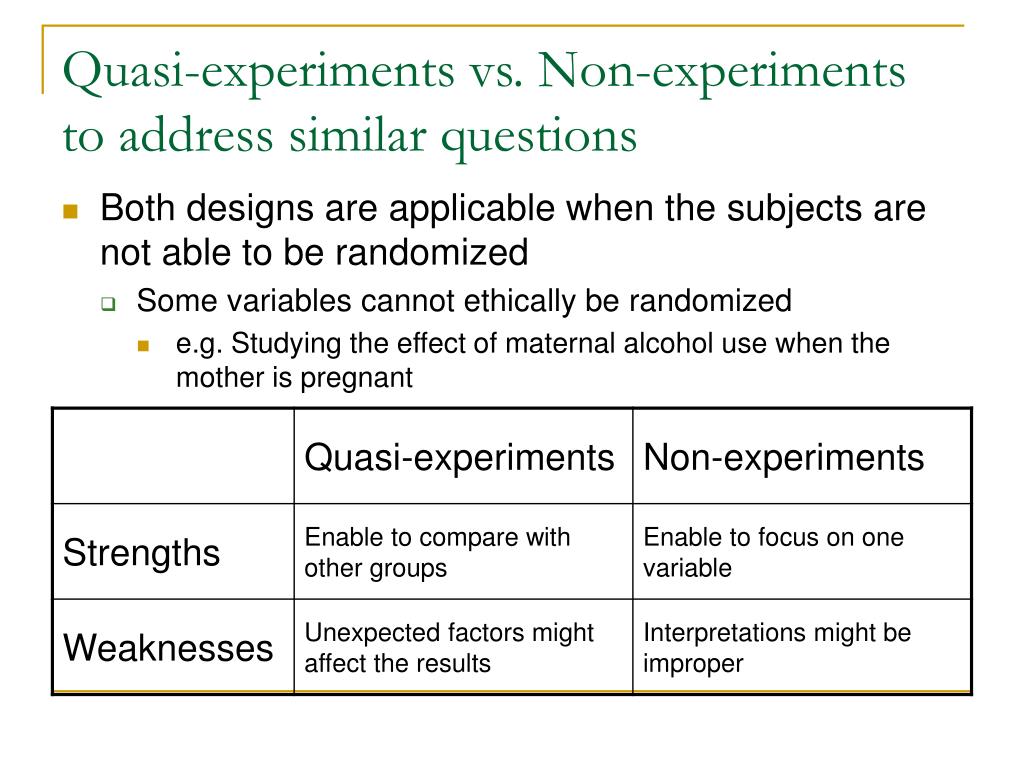
QEDs test causal hypotheses but, in lieu of fully randomized assignment of the intervention, seek to define a comparison group or time period that reflects the counter-factual (i.e., outcomes if the intervention had not been implemented) (43). QEDs seek to identify a comparison group or time period that is as similar as possible to the treatment group or time period in terms of baseline (pre-intervention) characteristics. QEDs can include partial randomization such as in stepped wedge designs (SWD) when there is pre-determined (and non-random) stratification of sites, but the order in which sites within each strata receive the intervention is assigned randomly. For example, strata that are determined by size or perceived ease of implementation may be assigned to receive the intervention first.
Characterize fidelity and measures of implementation processes
External validity can be improved when the intervention is applied to entire communities, as with some of the community-randomized studies described in Table 2 (12, 21). In these cases, the results are closer to the conditions that would apply if the interventions were conducted ‘at scale’, with a large proportion of a population receiving the intervention. If the average posttest score is better than the average pretest score, then it makes sense to conclude that the treatment might be responsible for the improvement. Unfortunately, one often cannot conclude this with a high degree of certainty because there may be other explanations for why the posttest scores are better.
STRATEGIES TO STRENGTHEN EXTERNAL VALIDITY
Matching can be based on demographic and other important factors (e.g. measures of health care access or time-period). Table 1 summarizes the main QEDs that have been used for prospective evaluation of health intervention in real-world settings; pre-post designs with a non-equivalent control group, interrupted time series and stepped wedge designs. We do not include pre-post designs without a control group in this review, as in general, QEDs are primarily those designs that identify a comparison group or time period that is as similar as possible to the treatment group or time period in terms of baseline (pre-intervention) characteristics (50). Below, we describe features of each QED, considering strengths and limitations and providing examples of their use. Detailed reviews have been published of variations on the basic ITS design that can be used to enhance causal inference.
Observational Research – Methods and Guide
Effectiveness of implementing evidence-based approaches to promote physical activity in a Midwestern micropolitan ... - BMC Public Health
Effectiveness of implementing evidence-based approaches to promote physical activity in a Midwestern micropolitan ....
Posted: Fri, 19 Apr 2024 01:43:12 GMT [source]
Another alternative explanation for a change in the dependent variable in a pretest-posttest design is regression to the mean. This refers to the statistical fact that an individual who scores extremely on a variable on one occasion will tend to score less extremely on the next occasion. For example, a bowler with a long-term average of 150 who suddenly bowls a 220 will almost certainly score lower in the next game. Regression to the mean can be a problem when participants are selected for further study because of their extreme scores. Imagine, for example, that only students who scored especially low on a test of fractions are given a special training program and then retested. Regression to the mean all but guarantees that their scores will be higher even if the training program has no effect.
This design involves selecting participants based on a specific cutoff point on a continuous variable, such as a test score. Participants on either side of the cutoff point are then compared to determine whether the intervention or event had an effect. Quasi-experimental design is a research method that seeks to evaluate the causal relationships between variables, but without the full control over the independent variable(s) that is available in a true experimental design.
Research Methods in Psychology

We conclude with a brief discussion of incorporating additional design elements to capture the full range of relevant implementation outcomes in order to maximize external validity. In comparison to simple pre-post designs in which the average outcome level is compared between the pre- and post-intervention periods, the key advantage of ITS designs is that they evaluate for intervention effect while accounting for pre-intervention trends. Such trends are common due to factors such as changes in the quality of care, data collection and recording, and population characteristics over time. In addition, ITS designs can increase power by making full use of longitudinal data instead of collapsing all data to single pre- and post-intervention time points. The use of longitudinal data can also be helpful for assessing whether intervention effects are short-lived or sustained over time.
This can be challenging as there may not be adequate information available to determine how ‘equivalent’ the comparison group is regarding relevant covariates. Researchers can use this method to determine whether a particular intervention has had an impact on the target population over time. This design involves measuring the dependent variable(s) before and after an intervention or event, but without a control group. This design can be useful for determining whether the intervention or event had an effect, but it does not allow for control over other factors that may have influenced the outcomes.
Pre-Post With Non-Equivalent Control Group
However, within those strata the specific sites themselves are randomly selected to receive the intervention across the time intervals included in the study). In all cases, the key threat to internal validity of QEDs is a lack of similarity between the comparison and intervention groups or time periods due to differences in characteristics of the people, sites, or time periods involved. Randomized controlled trials (RCTs) in which individuals are assigned to intervention or control (standard-of-care or placebo) arms are considered the gold standard for assessing causality and as such are a first choice for most intervention research. Random allocation minimizes selection bias and maximizes the likelihood that measured and unmeasured confounding variables are distributed equally, enabling any difference in outcomes between intervention and control arms to be attributed to the intervention under study.
There is a consistently high number of absences before the treatment, and there is an immediate and sustained drop in absences after the treatment. The bottom panel of Figure 7.5 “A Hypothetical Interrupted Time-Series Design” shows how the data might look if this treatment did not work. This figure also illustrates an advantage of the interrupted time-series design over a simpler pretest-posttest design.
What factors will affect the effectiveness of using ChatGPT to solve programming problems? A quasi-experimental ... - Nature.com
What factors will affect the effectiveness of using ChatGPT to solve programming problems? A quasi-experimental ....
Posted: Mon, 26 Feb 2024 08:00:00 GMT [source]
This would be a nonequivalent groups design because the students are not randomly assigned to classes by the researcher, which means there could be important differences between them. For example, the parents of higher achieving or more motivated students might have been more likely to request that their children be assigned to Ms. Williams’s class. Or the principal might have assigned the “troublemakers” to Mr. Jones’s class because he is a stronger disciplinarian. Of course, the teachers’ styles, and even the classroom environments, might be very different and might cause different levels of achievement or motivation among the students. If at the end of the study there was a difference in the two classes’ knowledge of fractions, it might have been caused by the difference between the teaching methods—but it might have been caused by any of these confounding variables. It has been observed that it is more difficult to conduct a good quasi-experiment than to conduct a good randomized trial (43).
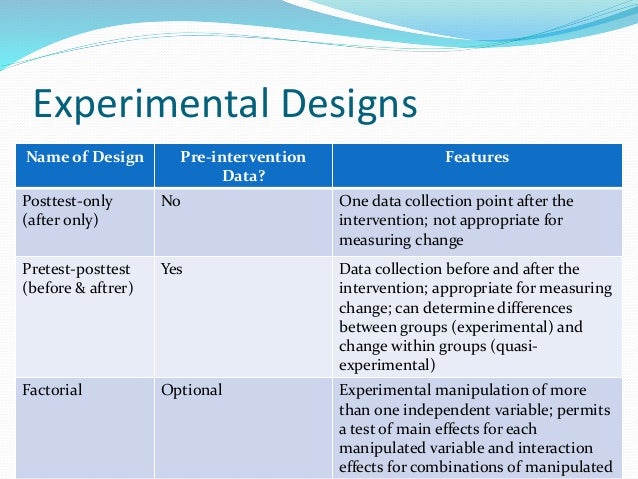
Implicit in this approach is the assumption that the greater the similarity between groups, the smaller the likelihood that confounding will threaten inferences of causality of effect for the intervention (33, 47). Overall, the purpose of quasi-experimental design is to provide a rigorous method for evaluating the impact of interventions, policies, and programs while controlling for potential confounding factors that may affect the outcome. In one classic example, the treatment was the reduction of the work shifts in a factory from 10 hours to 8 hours (Cook & Campbell, 1979). Because productivity increased rather quickly after the shortening of the work shifts, and because it remained elevated for many months afterward, the researcher concluded that the shortening of the shifts caused the increase in productivity. Notice that the interrupted time-series design is like a pretest-posttest design in that it includes measurements of the dependent variable both before and after the treatment.
This design involves studying the effects of an intervention or event that occurs naturally, without the researcher’s intervention. For example, a researcher might study the effects of a new law or policy that affects certain groups of people. At this design stage, the first step at improving internal validity would be focused on selection of a non-equivalent control group(s) for which some balance in the distribution of known risk factors is established.
This inverse roll-out enabled the investigators to start with a smaller clinic, to work out the logistical considerations, but then influence the roll-out such as to avoid clustering of smaller or larger clinics in any one step of the intervention. In order to enhance the causal inference for pre-post designs with non-equivalent control groups, the best strategies improve the comparability of the control group with regards to potential covariates related to the outcome of interest but are not under investigation. One strategy involves creating a cohort, and then using targeted sampling to inform matching of individuals within the cohort.
We present a decision ‘map’ approach based on a Figure 5 to assist in considering decisions in selecting among QEDs and for which features you can pay particular attention to in the design [Figure 5 here].
When participants are not randomly assigned to conditions, however, the resulting groups are likely to be dissimilar in some ways. A nonequivalent groups design, then, is a between-subjects design in which participants have not been randomly assigned to conditions. These types of studies are well-suited to settings where there is routine enumeration of a cohort based on a specific eligibility criteria, such as enrolment in a health plan or employment group, or from a disease-based registry, such as for diabetes (27, 42). It has also been reported that this design can increase efficiency and statistical power in contrast to cluster-based trials, a crucial consideration when the number of participating individuals or groups is small (22).


No comments:
Post a Comment